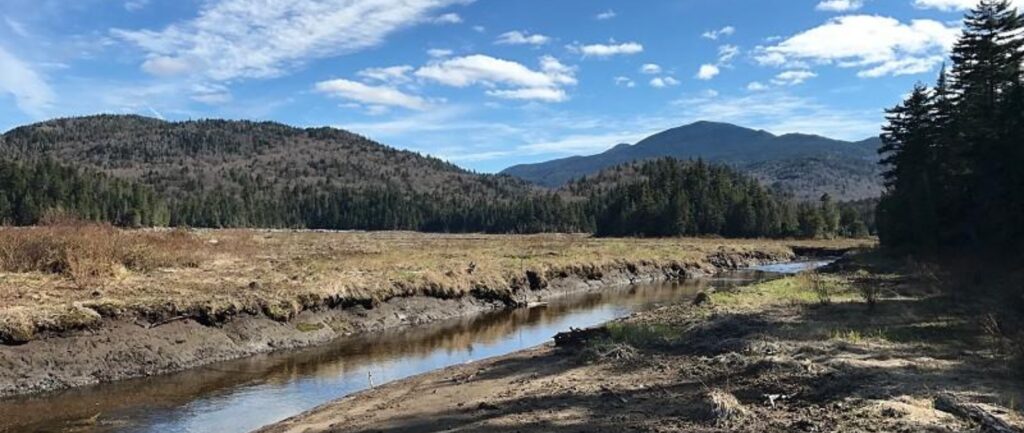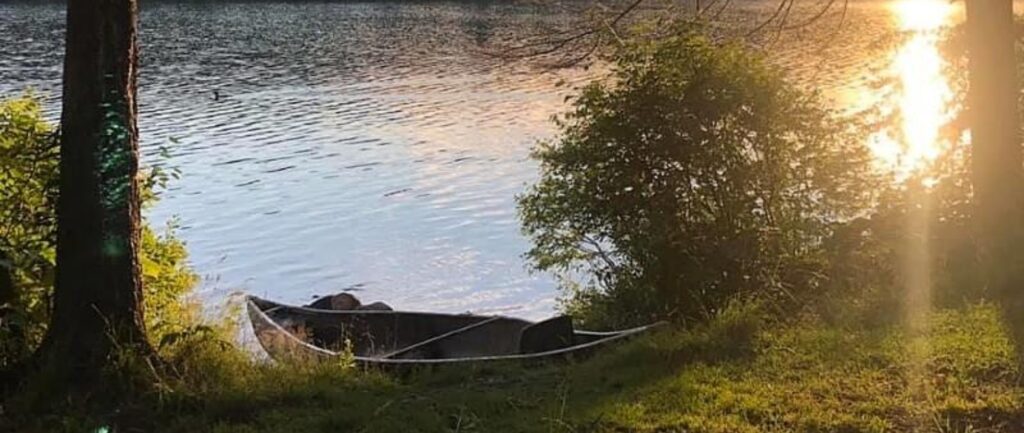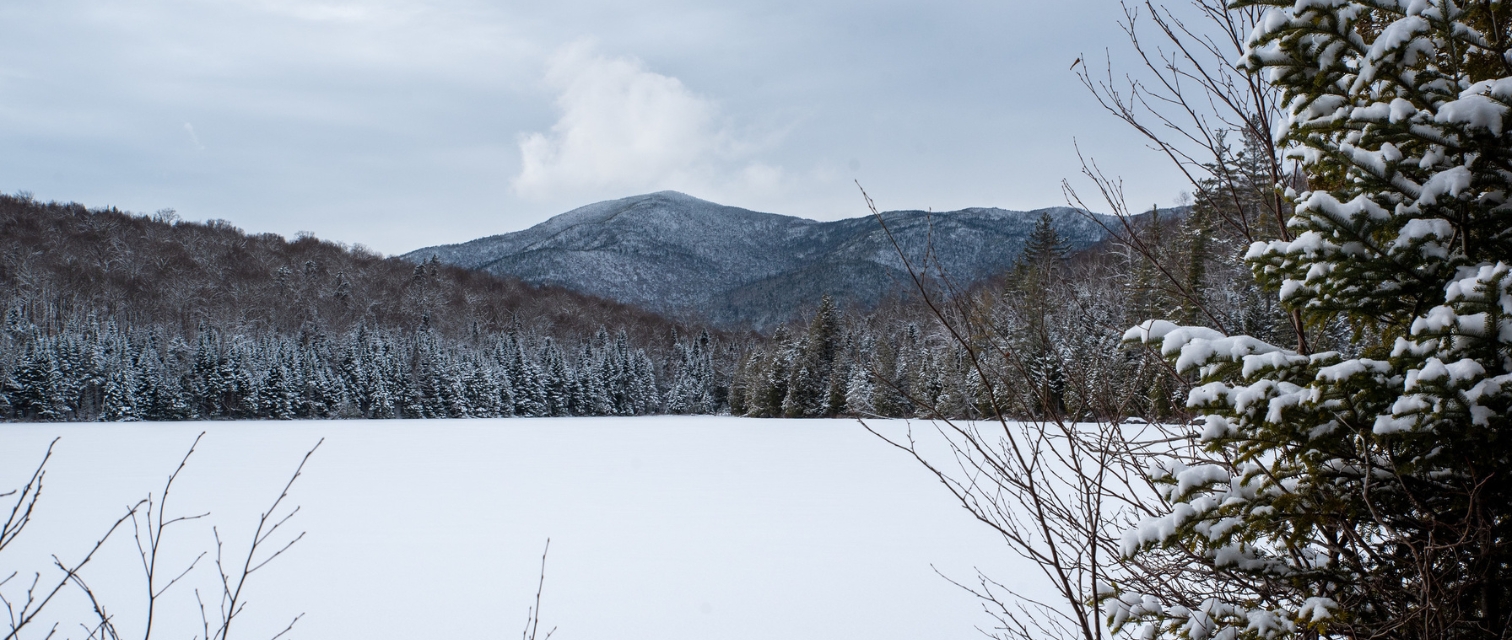
Long before Adirondak Loj existed, campers and trampers, scientists and sportsmen retreated to the eastern shore of Heart Lake. By 1865, the lake, then called Clear Pond, was already distinguished as the loveliest water in the forest. “Among the beautiful waters of the wilderness, this heart-shaped pond is one of the most beautiful. Sparkling like a gem in its depth of woods, it rejoices in its loveliness, only for the most part in behalf of the fauns and dryads,” wrote author, poet, and New York State law librarian Alfred Billings Street.
Street and his guide camped at Clear Pond, “upon a small point which thrust its tongue out as if to lap the diamond waters.” Street watched the night scene and then wearily threw himself “upon a mossy mound as in a downy cradle, and slept.” The mossy mound was probably on the east shore of Clear Pond where Adirondak Loj now stands.
A few years after Street’s visit, author Charles Dudley Warner camped at Clear Pond and supposedly failed to extinguish his campfire. The fire created the large clearing between the present Adirondak Loj and beach area.
Another famous man, Verplanck Colvin, state surveyor and superintendent of the great Adirondack Survey, camped at Clear Pond on September 7, 1873. He arrived in true Colvin fashion, “by a rapid march through the unknown forest…concluded to make a push for Clear Pond even if it took a night march. . . . Accordingly, we set out and made a hard march, the trail being obscure and much fallen timber in the way. Reached Clear Pond about 10 p.m.” No doubt they camped in the clearing beside the pond.
Four years later, a young electrician and inventor named Henry Van Hoevenberg traveled to the Adirondacks to seek relief from hay fever. He camped on Upper Ausable Lake with some friends, including Josephine Scofield, of whom he grew quite fond. One day they climbed Mount Marcy and from the summit selected a beautiful spot on the shore of Clear Pond as the location for a huge log home.
The heart-shaped pond lay surrounded by wilderness, with a craggy mountain rising from its northern shore. Van Hoevenberg immediately named the little peak Mount Jo, in honor of Miss Scofield. Tragically, she died within a few months. Evidence asserts that Jo (actually Jane Schofield from Ontario, Canada) suffered from consumption and jumped over Niagara Falls to escape her pain or perhaps to declare her love of Van Hoevenberg and avoid a forced marriage to a Toronto businessman.
After her death, Van Hoevenberg spent huge sums of money he had earned from his inventions regarding improvements to the printing telegraph to carry out their plans. This 5-foot-4-inch man had more impact than any visitor before or after him; he changed forever that mossy mound beside Clear Pond.
Mr. Van
Henry Van Hoevenberg, the man affectionately known as “Mr. Van,” purchased 640 acres surrounding Clear Pond. He proclaimed it “the finest square mile in which to get closest to Nature” and erected Adirondack Lodge, an enormous rustic structure with a seven-story tower, on the east shore of the lake. For over twenty years, his Adirondack Lodge was said to be the largest log building in the world and was heralded as a comfortable woods retreat. It welcomed sportsmen and tourists along with well-known artists, authors, and professors.
Some sportsmen criticized Mr. Van for “bringing the first bathtub and tennis set to the Adirondacks and for trying to force such extravagance into the woods.” But the guests enjoyed the indoor comforts and the outdoor activities. Tennis courts occupied the opening that is now the Adirondak Loj front lawn.
Unfortunately, in the 1890s, Mr. Van found himself in financial trouble because of lawsuits concerning infringements on his patents. To cover his debts, he was forced to sell the Adirondack Lodge. An 1894 land deed recorded the sale of “that piece or parcel of land with the lakes, mountains, buildings and lodges thereon…all the personal property…including all furniture, equipment, utensils, books, pictures, boats, wagons, and other chattels except only the wearing apparel, firearms, and sword.”
Ownership of the property changed several times until, in 1900, Mr. Van’s employer, the Lake Placid Club, bought it and held it for 59 years. The Club Handbook encouraged members to visit Adirondack Lodge at Heart Lake: “The builder of the Lodge [Mr. Van] with a force of men spent the winter in needed restorations and renovations and it will open July 1, 1901….New equipment, boats, livery, furniture, linen and china supplement the renovation of the building.”
The Lake Placid Club, founded and controlled by Melvil Dewey (world-renowned for his creation of the Dewey Decimal Classification System once used in many libraries and for his crusades in metric reform and spelling reform), brought changes to Adirondack Lodge. Club personnel controlled finances. Club rules applied: no drinking, no gambling, no noise after 10 p.m. The name of the pond officially changed to Heart Lake. Later, Dewey would implement his passion for spelling reform, calling the lake “Hart Lake” and the lodge “Adirondak Loj.”
Trial by fire
The club’s revitalization of the grand lodge was short-lived. On June 3, 1903, fires approached Adirondack Lodge. Mr. Van mounted the lodge tower and tried to look out over the smokey treetops. He could see the flames surging down from Mount Jo; he was being hemmed in by the fires and the lodge was doomed.
Mr. Van and his men escaped to Indian Pass. After hours of waiting in the darkness, the men heard a great crash and knew that the lodge tower had fallen. “The Adirondack Lodge had passed into the Land of Things that Were,” wrote Alfred Donaldson.
The men walked back to the lodge the next morning. The ground was black and almost every tree was burned. All that remained of the lodge were some large cellar holes. Fifteen of the buildings had been destroyed. The only building still standing was the flimsy bark shelter near the clearing; it contained a half box of dynamite for building another tennis court. Mr. Van stuffed the dynamite under his coat, ran across the smoldering ground to the lake, and tossed the explosives into the water. The water level in Heart Lake had been lowered about a foot, and along the east shore dead fish had been boiled to rags.
Melvil Dewey notified Lake Placid Club members that “as fast as possible at any reasonable cost the blackened surface will be covered again with foliage, new trees started and a new Lodge spring up on the shores of what was meant for the most attractive spot in all the great wilderness. . . . Keep a warm place in your heart for the home in the forest of which we were all so fond, and before long we shall meet again on the shores of the little lake in the Heart of the Adirondacks. The Lodge is dead. Long live the Lodge!”
But the lodge was not rebuilt. Instead, lumber camps and a temporary house of bare, unpainted lumber were erected on the shore of Heart Lake near the original lodge site. Finally, in the 1920s, acres of red and white pine were planted by Harry Wade Hicks, Jed Rossman, and others. The plantings started at the bridge over Marcy Brook and continued along the road to Heart Lake and then farther south. The one-year transplants from the state nursery near Paul Smith’s cost five dollars per thousand. Today those tiny transplants provide cool shade and a soft carpet on the east shore of Heart Lake.
In early 1927, Harry Wade Hicks, secretary of the Lake Placid Club, spent the night with Jed Rossman in his shack at Heart Lake. The next morning Hicks walked to the center of the ice-covered lake to watch the sunrise. He was inspired by the beautiful scene and conceived a plan to rebuild Adirondack Lodge.
The plans moved forward with funds coming from members of the Camp and Trail Club and Sno Birds organizations of the Lake Placid Club. The club hired Saranac Lake architect William G. Distin to design a new lodge.
Distin understood the enormous task of trying to replace the famous Adirondack Lodge. His father, a professional photographer, had photographed the illustrious structure and grounds. As a young lad, William had himself visited the original lodge just a week before it burned in 1903.
Latter-day Phoenix
Construction of the new lodge began in the spring of 1927. In June, the Lake Placid Club reported (in simplified spelling which Dewey insisted be used in all club correspondences): “The new all-year camp at Adirondak Loj has been started. Funds hav been secured, plans approved and the camp will be redy for use in October.” The new lodge welcomed its first guests on December 26, 1927.
Twenty-four years after fire destroyed the original Adirondack Lodge, a new lodge was open, “largely restoring to its former glory one of America’s most attractive tramping and camping centers.” Melvil Dewey had made good on his promise to resurrect the lodge. Long live the Lodge!
Now, however, Dewey used simplified spelling, so the camp was named “Adirondak Loj.” The new lodge stood at the eastern edge of the clearing, behind the old tennis courts, several yards north of the old Adirondack Lodge site.
Once again campers and trampers rested “upon a mossy mound as in a downy cradle, and slept.” But now they rested in bunkrooms or private rooms. A large living room served as a dining room and had a loft for overflow guest quarters.
One guest commented, “Furnace heat, electric lights, unlimited hot water, shower baths, a commodious drying room for wet clothing, good bunk rooms with comfortable bunks, a spacious fireplace and plenty of lounging chairs, and plain but delicious meals, all contribute to the attraction of this ideal climbing center, adapted for every season of the year.” Another remarked, “The happy but tired skier is glad to join the circle about the huge fireplace, and to let the warmth of the flames and the soothing crackle of the logs relax his taught muscles and lend color to his story of the day’s adventure.”
Evidently the Depression years reduced the use of the Adirondak Loj by Lake Placid Club members. The club was in financial trouble and decided to sell the desirable property in the spring of 1932. The Loj was put up for sale and was rumored to attract offers from persons interested in making it a speakeasy.
Frederick T. Kelsey, a governor of the new Adirondack Mountain Club (ADK) and a member of the Lake Placid Club, put a stop to that. He organized the Adirondak Loj Corporation and negotiated a long-term lease of the new lodge. For the next twenty-five years, he personally paid the lease and expenses of the Loj.
Kelsey opened the property to the general public, eliminated simplified spelling (except for Adirondak Loj), lowered the cost of meals, and promoted the recreational and conservation aims of the Adirondack Mountain Club. The Adirondak Loj brochure reiterated the creed of all those who visit Heart Lake: “For those who love the North woods, the Loj situated at the foot of the highest Adirondack peaks, in a setting not surpassed for beauty, presents an ideal camp de-luxe. Fresh air, good fellowship, glorious hikes and climbs, and comfort and good comradeship at night about the fireplace combine to make it unique. Adirondak Loj is at the end of the road and the beginning of the trampers’ and skiers’ paradise.”
ADK steps in
When Kelsey died suddenly in 1957, the Lake Placid Club decided to sell the property rather than continue to lease it. It wanted to sell it to the state or to some non-profit organization that would care for the property, so the Lake Placid Club offered the Loj to ADK for just $35,000. Even though it was a very reasonable price, the purchase would be a great undertaking for the Club, with just over 2000 members, little money, and no lodge management experience. Members responded, “Oh, we cannot let it go!”
The ADK Board of Governors voted to approve the purchase because the property seemed an ideal location for members and others wanting to go hiking, climbing, camping, and fishing in the High Peaks area. The Board “felt that the club would be materially strengthened in what it could offer its members and that it would become a focal point for the conservation program and eventually become its central headquarters.” Thus, on April 1, 1959, ADK purchased the Loj and the 640-acre tract (actually, it turned out to be 704 acres).
It is amazing how little this camping and tramping center changed from 1878 to 1999 [to the present]. Heart Lake is still the loveliest water in the forest and Adirondak Loj offers the same hospitality and woodsy comfort started by Henry Van Hoevenberg. Food is still hearty, not fancy. Occasionally, tennis balls are tossed on the cleared lawn of Adirondak Loj. Lights still go out at 10 p.m. so sleepy heads can rest on the mossy mound.
This article was written by Sandra Weber and originally printed in the March/April 1999 issue of Adirondac magazine. Weber wrote The Finest Square Mile: Mount Jo and Heart Lake in 1998. Since then, she has authored several books, including Mount Marcy, Breaking Trail (co-author Peggy Lynn), Adirondack Roots, John Brown in New York, and John Brown Farm.